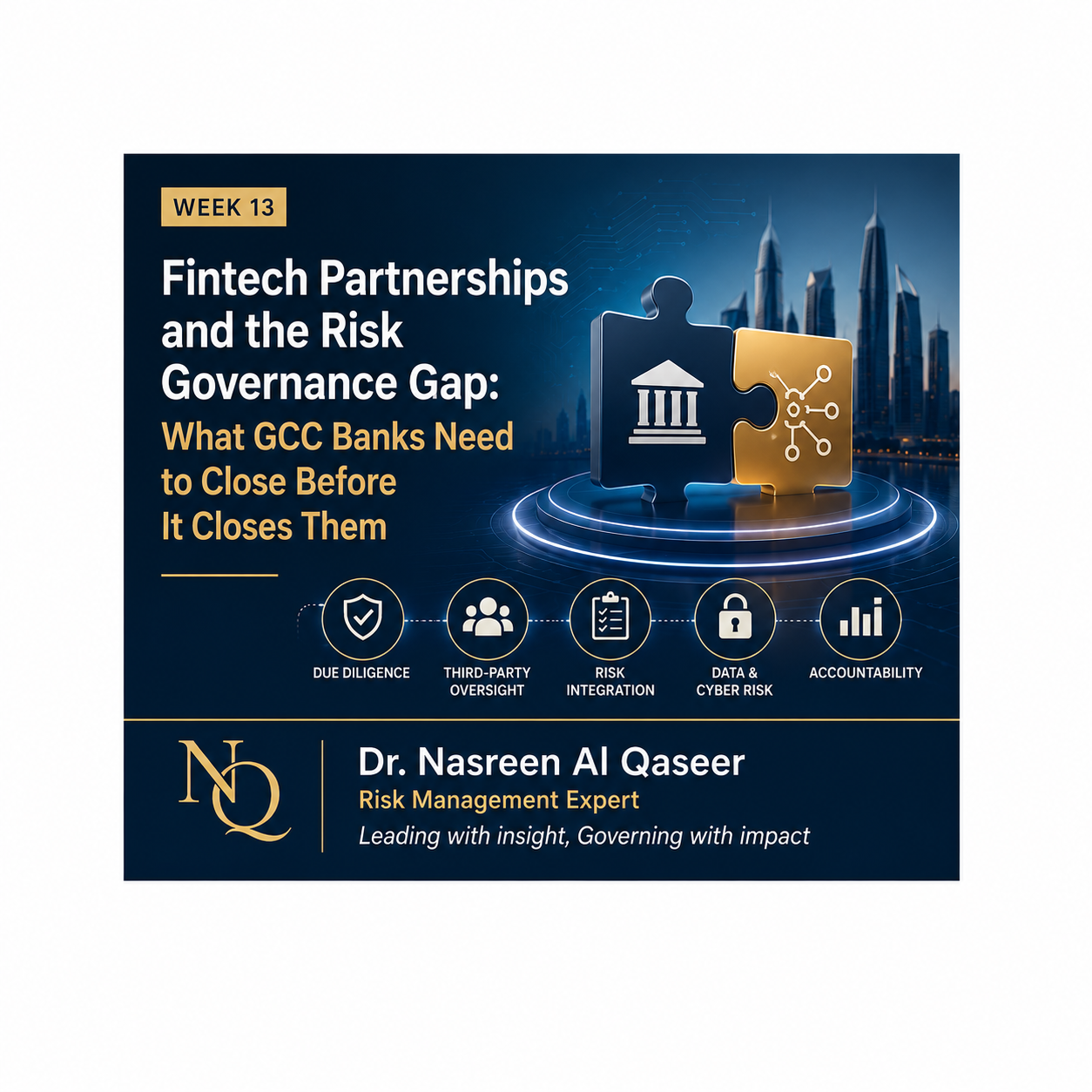
Fintech Partnerships and the Risk Governance Gap: What GCC Banks Need to Close Before It Closes Them
In this article
At a glanceWhy fintech partnerships create risks that traditional vendor frameworks don't fully coverWhat the governance framework needs to coverWhat regulators are watchingWhere this leaves risk leadersBoardroom questionsContinue readingAt a glance
Why fintech relationships need oversight beyond onboarding, with clear customer accountability, data governance, ongoing monitoring and exit planning.
GCC banks are partnering with fintechs at a pace that would have been difficult to imagine five years ago. Payments, lending, KYC, wealth management, trade finance, treasury operations. The partnerships are real, the innovation is genuine, and the risk governance frameworks meant to oversee them are, in most institutions I've observed, running at least two years behind.
This is not an argument against fintech partnerships. The competitive and customer pressure driving them is real, and the institutions that don't find ways to modernize through partnership will face their own strategic risks. It is an argument for building the risk governance architecture that makes these partnerships sustainable rather than discovering its absence through an incident.
The risk governance gap in fintech partnerships is not primarily about due diligence at onboarding, though that is often weaker than it should be. It is about what happens after the partnership is live, when the fintech is embedded in customer-facing processes, handling sensitive data, or sitting inside the credit or payments infrastructure of a regulated institution, and the governance framework hasn't kept pace with how central that relationship has become.
Why fintech partnerships create risks that traditional vendor frameworks don't fully cover
The standard third-party risk framework, which I covered in an earlier piece in this series, was largely built around traditional vendor relationships: a supplier provides a defined service, the bank assesses and monitors that supplier's risk, and the relationship is bounded by a clear contractual scope.
Fintech partnerships often don't fit that shape. A fintech may be providing a technology layer that sits directly in the customer journey, making credit decisions, processing payments, or collecting and processing sensitive financial data in ways that are deeply integrated with the bank's own operations. The boundary between what the fintech does and what the bank does is genuinely blurry, and that blurriness creates risk management complexity that a standard vendor framework wasn't designed to handle.
The first dimension of that complexity is regulatory accountability. The bank remains fully responsible to its regulator for everything that happens in the customer relationship, regardless of which part of the technology stack a fintech is operating. A fintech that makes a poor credit decision on the bank's behalf, that mishandles customer data, or that facilitates a transaction that should have been flagged for AML review has created regulatory exposure for the bank, not just for itself. Most fintech partnership agreements acknowledge this in principle. Fewer have governance structures that actually operationalize it.
The second dimension is data risk. Fintechs operate on data, and fintech partnerships almost always involve sharing customer data, transaction data, or behavioral data with a third party. The question of what data is shared, how it's used, how it's protected, and what happens to it if the partnership ends is a risk and governance question that requires the CRO's active involvement, not just a legal review of the data sharing agreement.
The third dimension is concentration and dependency risk. Institutions that have moved significant customer-facing processes onto a fintech platform have, sometimes without fully recognizing it, created a critical operational dependency. If the fintech fails, is acquired, changes its commercial terms, or suffers a significant operational incident, the bank's ability to serve customers in that area may be materially impaired. That dependency should be assessed, governed, and planned for with the same rigor applied to any other critical operational dependency.
What the governance framework needs to cover
A risk governance framework adequate to fintech partnerships needs to address five things that standard vendor frameworks often leave incomplete.
The first is proportionate due diligence that reflects actual risk, not just partnership size. A small fintech embedded in the credit decisioning process for retail lending is a higher governance priority than a large fintech providing a back-office reporting tool. Tiering by actual risk exposure, not by contract value or counterparty size, is the starting point.
The second is ongoing monitoring that matches the pace of change in fintech businesses. Fintechs change faster than traditional vendors: they raise new funding rounds, pivot their business models, onboard new sub-processors, change their technology infrastructure, and sometimes fail with limited warning. Annual reviews are not adequate for relationships where the risk profile can change materially in months.
The third is clear accountability mapping for every customer outcome the partnership touches. For each fintech partnership, the institution should be able to answer: if a customer is harmed by something that happens in this partnership, who is accountable, how does the bank find out, and what is the remediation process. If that accountability is unclear, the governance gap is real.
The fourth is data governance that covers the full data lifecycle, not just the initial sharing agreement. What data does the fintech hold on the bank's customers, how is it protected, how is it used beyond the immediate purpose of the partnership, and what happens to it if the relationship ends. These questions should be answered before the partnership goes live and monitored throughout its duration.
The fifth is exit planning. For any fintech relationship that has become operationally critical, the institution should have a tested plan for transitioning away from that relationship within an acceptable timeframe. This is the same discipline I described for vendor risk generally, and it is even more important for fintech partnerships where the technology dependency can deepen quickly and quietly.
What regulators are watching
CBB and regional regulators are paying increasing attention to fintech partnerships, both as part of their broader third-party risk oversight and specifically in the context of open banking, digital lending, and embedded finance frameworks that are being developed across the region. The regulatory direction is toward institutions demonstrating that they maintain genuine oversight and accountability over fintech partners operating within their regulatory perimeter, not just contractual protections that may be difficult to enforce.
For institutions that have moved quickly into fintech partnerships, a governance review that honestly assesses where the framework has gaps relative to regulatory expectations is worth doing now rather than after a regulatory examination surfaces it.
Where this leaves risk leaders
If you're assessing your institution's fintech partnership governance, five honest questions cut through the complexity: 1. do you have a complete inventory of your fintech partnerships and an honest assessment of which ones are genuinely operationally critical; 2. are you monitoring those partnerships at a frequency that matches how fast fintech businesses change; 3. is accountability for every customer outcome clearly mapped and operationalized; 4. do you have visibility into how your fintech partners are using and protecting customer data beyond the initial agreement; 5. and have you tested your exit plan for your most critical fintech dependency.
Most institutions will find they moved faster into partnerships than their governance framework moved to cover them. The gap is closable. The starting point is knowing where it actually is.
Where is your institution in building a governance framework adequate to the fintech partnerships you've already entered into?
Boardroom questions
- Which fintech partners are operationally critical?
- Who is accountable for each customer outcome?
- When did we last test an exit plan for a critical partner?