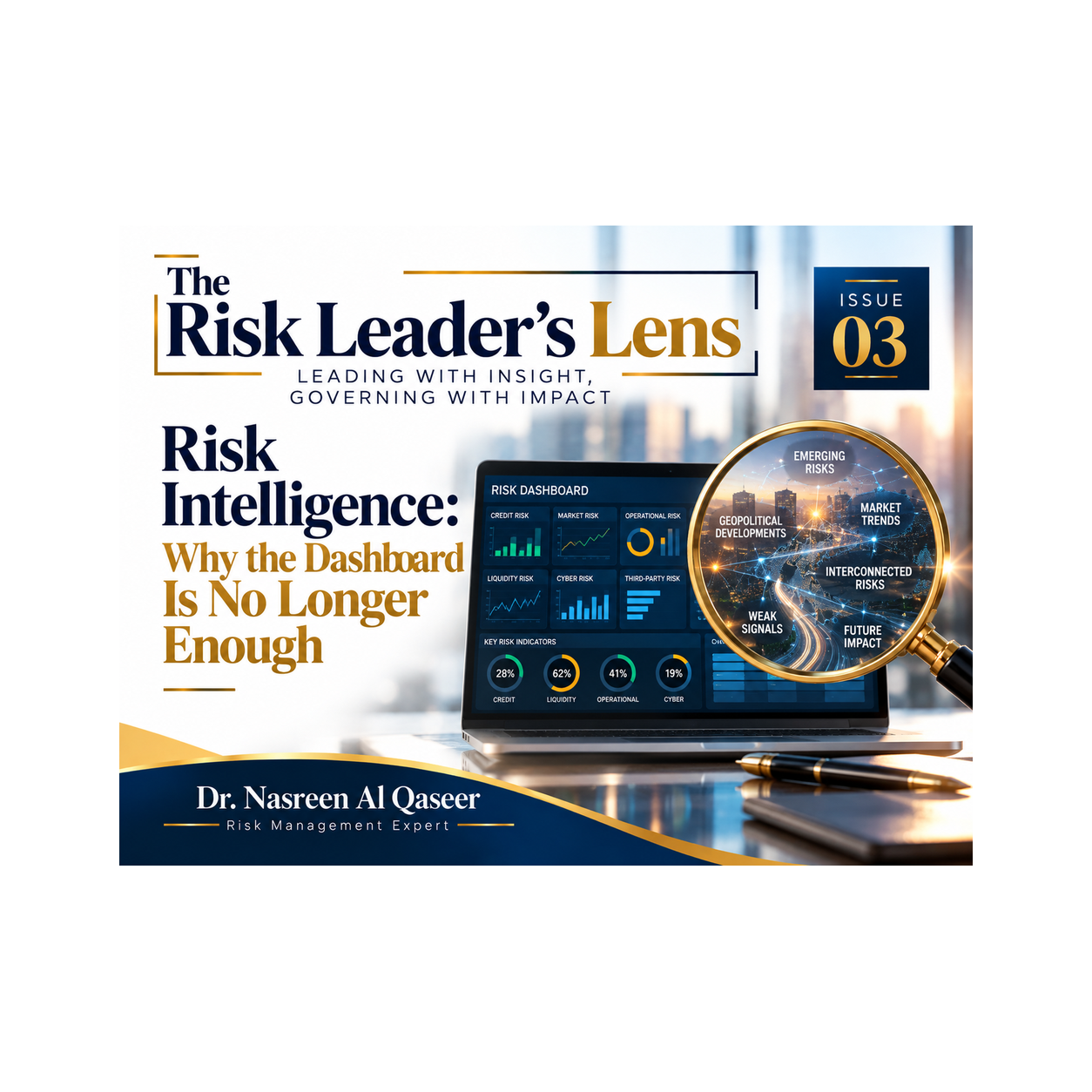
Boards today receive more risk information than at any point in the past.
Dashboards are richer. KRIs are more sophisticated. Data arrives faster. Reporting is increasingly automated.
Yet one important question remains:
Are boards becoming better informed, or simply receiving more information?
The distinction matters
A dashboard can tell leadership where the institution stands today.
But effective risk leadership increasingly requires something more:
The ability to understand where risk may be moving next.
That is the difference between risk reporting and risk intelligence.
THE SIGNAL - More Data Does Not Automatically Mean More Insight
Modern risk dashboards provide enormous value.
They bring together exposures, limits, trends, breaches, concentrations and emerging issues into a structured view.
But dashboards have a natural limitation.
They are largely built around risks we already know how to measure.
The next significant risk may not yet have crossed a threshold.
It may appear first as a weak signal: changing customer behaviour, increasing dependency on a critical third party, unusual transaction patterns, deterioration in a sector, geopolitical tension, technology concentration, changing workforce behaviour or a series of small operational events that appear unrelated.
Individually, none may justify a red indicator.
Together, they may be telling leadership something important.
THE BLIND SPOT - When Green Becomes Comfortable
One of the most powerful features of a dashboard is simplicity.
Red requires attention.
Amber requires monitoring.
Green provides assurance.
But risk rarely develops according to colour.
A green indicator can still be moving rapidly toward amber.
Several green indicators can also interact and create an exposure that is not visible when each risk is considered separately.
This creates a potential blind spot.
Boards can receive accurate information and still miss the emerging story.
The challenge is therefore not simply to improve reporting.
It is to improve interpretation.
THE LEADERSHIP QUESTION - What Is the Dashboard Not Telling Us?
Risk committees naturally spend time discussing exceptions, breaches and areas outside appetite.
That is appropriate.
But mature risk oversight should also create space for a different conversation:
What are we seeing that has not yet become a formal risk issue?
This changes the discussion.
Instead of focusing only on what has already happened, leadership begins examining:
direction of travel;
emerging dependencies;
unusual correlations;
external developments;
changing assumptions;
near misses;
weak signals; and
risks that cut across traditional organizational boundaries.
This is where the CRO's role becomes particularly important.
The CRO should not simply bring the dashboard to the board.
The CRO should help the board see the story behind it.
MY LENS - Risk Leadership Begins Where Reporting Ends
Throughout my career in risk management, I have seen reporting capabilities become increasingly sophisticated.
That progress is important.
But I have also learned that the most valuable risk conversations often begin after the formal report has been presented.
The numbers tell us what.
Leadership judgment must ask why, what next and what are we missing?
For me, this is the essence of risk intelligence.
It is the ability to connect information across different risk categories, combine quantitative evidence with professional judgment, and recognize when several small signals may be pointing toward one larger development.
The strongest risk leaders do not simply report what the dashboard shows. They help leadership understand what the dashboard may not yet be showing.
FROM INSIGHT TO IMPACT - Five Ways to Strengthen Risk Intelligence
1. Add direction, not only position
A board should know not only whether an indicator is within appetite, but whether it is improving, deteriorating or accelerating.
2. Connect the risks
Credit, liquidity, cyber, operational, geopolitical and third-party risks should not always be discussed as separate worlds. Ask where they intersect.
3. Give weak signals a place
Not every concern deserves a new KRI. But emerging observations need a structured route into senior risk discussions before they become measurable events.
4. Discuss what changed
Rather than presenting the same dashboard each period, highlight what has materially changed in the institution's risk environment and why.
5. Make judgment visible
Where management judgment materially influences the interpretation of risk, boards should understand the assumptions behind that judgment.
THE BOARDROOM QUESTION
At the end of the next risk committee discussion, I would ask:
“What is the most important risk signal we are seeing today that is not yet clearly visible on this dashboard?”
The answer may not be precise.
That is exactly why the question matters.
Because by the time every emerging risk fits neatly into a metric, threshold and traffic light, leadership may already be responding to an event rather than anticipating one.
The future of risk leadership will not be defined by who produces the most sophisticated dashboard.
It will be defined by who can turn information into insight, and insight into timely action.
That is risk intelligence.
Dr. Nasreen Al Qaseer
Risk Management Expert
THE RISK LEADER’S LENS
Leading with Insight. Governing with Impact.
#RiskManagement #RiskIntelligence #ChiefRiskOfficer #BoardGovernance #KRIs #RiskReporting #CorporateGovernance #Banking #RiskLeadership #TheRiskLeadersLens