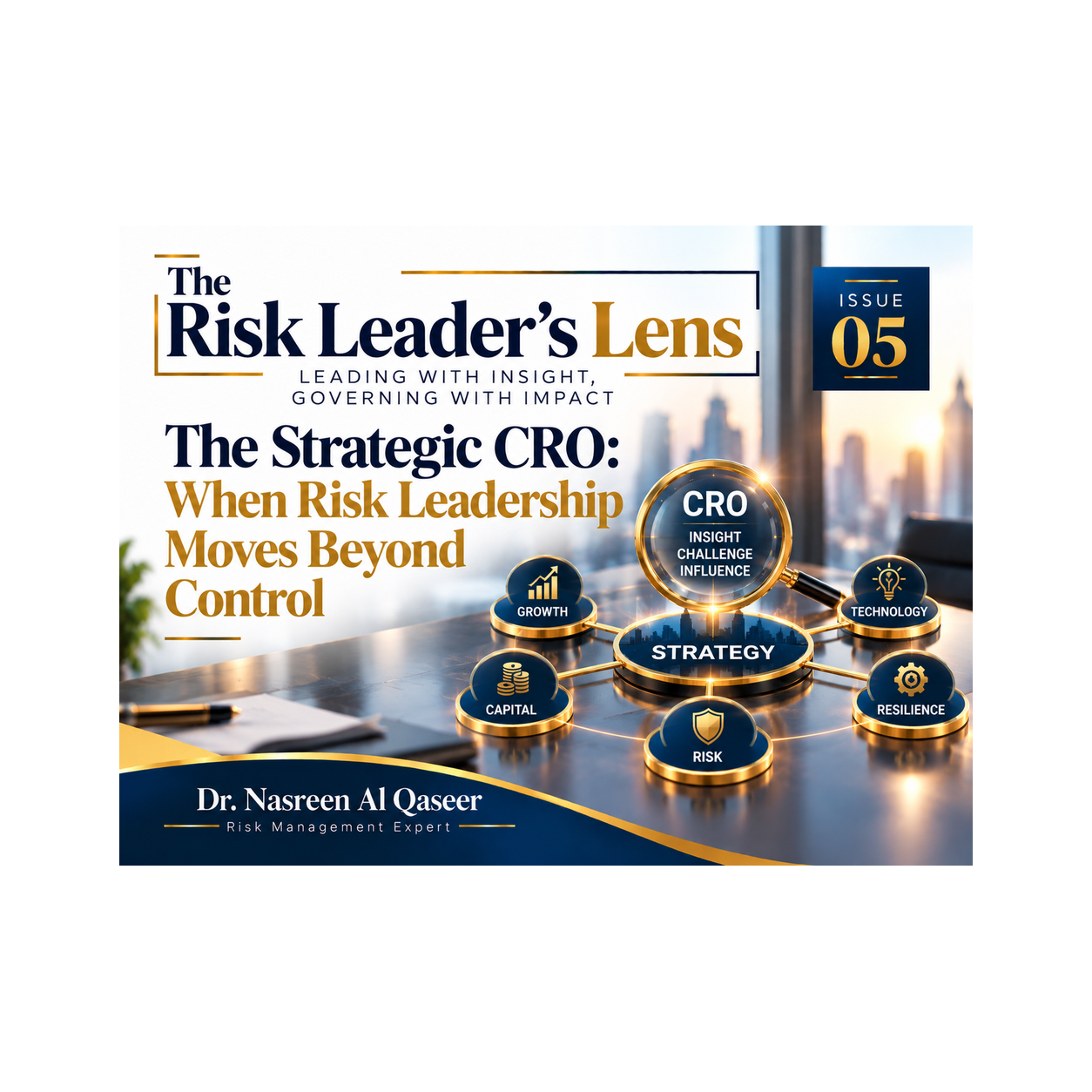
Leading with Insight. Governing with Impact.
For many years, the CRO has been defined by a clear mandate:
- Identify risk.
- Measure it.
- Monitor it.
- Challenge it.
- Report it.
These responsibilities remain fundamental.
But the environment in which the CRO operates has changed.
Strategy is moving faster. Risks are becoming more interconnected. Technology is reshaping business models. Geopolitical developments can alter assumptions quickly. Third-party dependencies are expanding. And decisions that once had relatively predictable risk consequences can now create exposures across several dimensions simultaneously.
This raises an important question:
If the CRO enters the conversation only when a decision is ready for challenge, has risk leadership entered too late?
THE SIGNAL — Risk Is Moving Upstream
Many of today's most important risks originate inside strategic choices.
Which markets should we enter?
Which technologies should we adopt?
Which activities should we outsource?
Which partnerships should we pursue?
How quickly should we grow?
Where should capital be deployed?
These are business decisions.
But they are also risk decisions.
By the time they reach a formal risk review, many assumptions may already have been accepted and momentum may already exist.
The strategic CRO therefore needs visibility before commitment becomes difficult to reverse.
Not to make the business decision.
But to improve it.
THE BLIND SPOT — Independence Can Be Misinterpreted as Distance
The independence of the risk function is essential.
It protects objective challenge and gives boards confidence that risk considerations are not being subordinated to commercial objectives.
But independence should not mean isolation.
A CRO who remains distant from strategy until formal approval may preserve independence—but lose the opportunity to influence the assumptions that created the risk in the first place.
The stronger model is different:
Close enough to understand the decision.
Independent enough to challenge it.
That balance is becoming one of the defining capabilities of modern risk leadership.
THE LEADERSHIP QUESTION — When Should the CRO Enter the Conversation?
The answer should not be “at the end.”
When management is considering a new market, major technology investment, acquisition, partnership, funding strategy or significant change in business model, risk leadership should be involved while options are still being shaped.
Early involvement allows the CRO to ask:
What assumptions are driving this decision?
What risks are we accepting?
Where are the concentrations?
What dependencies are we creating?
What happens under stress?
What might make this opportunity unattractive?
What would cause us to exit?
And perhaps most importantly:
Does the expected return justify the risk we are introducing?
These questions do not obstruct strategy.
They strengthen it.
MY LENS — Strategic Influence Without Losing Independence
Throughout my years in risk management, I have never believed that strong risk leadership means avoiding risk.
Financial institutions exist by taking risk.
The responsibility of the CRO is therefore not to eliminate uncertainty.
It is to help the institution understand it.
That distinction becomes increasingly important as the CRO moves closer to strategic decision-making.
The strategic CRO is not the executive who says yes to more risk. It is the executive who helps leadership understand which risks are worth taking—and which are not.
This requires judgment.
It requires commercial understanding without becoming commercially captured.
It requires confidence to challenge senior colleagues.
And it requires the ability to translate technical risk information into language that influences executive and board decisions.
The CRO's authority ultimately comes not only from the framework or reporting line.
It comes from the quality of the judgment brought to the table.
FROM INSIGHT TO IMPACT — Five Capabilities of the Strategic CRO
1. Enter strategic discussions earlier
Risk should contribute while options are being developed, not only when approval is requested.
2. Translate risk into business consequences
Boards and executives need to understand what a risk means for capital, liquidity, reputation, customers, resilience and strategic objectives—not simply its technical classification.
3. Connect risks across the organisation
The strategic CRO should see relationships between credit, market, liquidity, operational, cyber, third-party, geopolitical and emerging risks that individual functions may view separately.
4. Challenge assumptions, not only limits
A decision can remain within risk appetite and still depend on assumptions that deserve challenge.
5. Protect independence
Strategic involvement must never weaken the CRO's willingness or ability to say:
“This risk should not be taken.”
That remains fundamental.
THE BOARDROOM QUESTION
At the next strategic discussion, I would ask:
“At what point did the CRO become involved in shaping this decision?”
If the answer is only after the proposal was substantially complete, there may be an opportunity to strengthen the governance process.
The future CRO will still monitor limits.
Still challenge management.
Still protect the institution.
Still provide independent assurance to the board.
But the strongest CROs will also help leadership see the risk implications of a decision before those implications become exposures that need to be managed.
That is the evolution from risk control to risk leadership.
Not less independence.
More influence—with independence intact.
Dr. Nasreen Al Qaseer
Risk Management Expert
THE RISK LEADER’S LENS
Leading with Insight. Governing with Impact.